



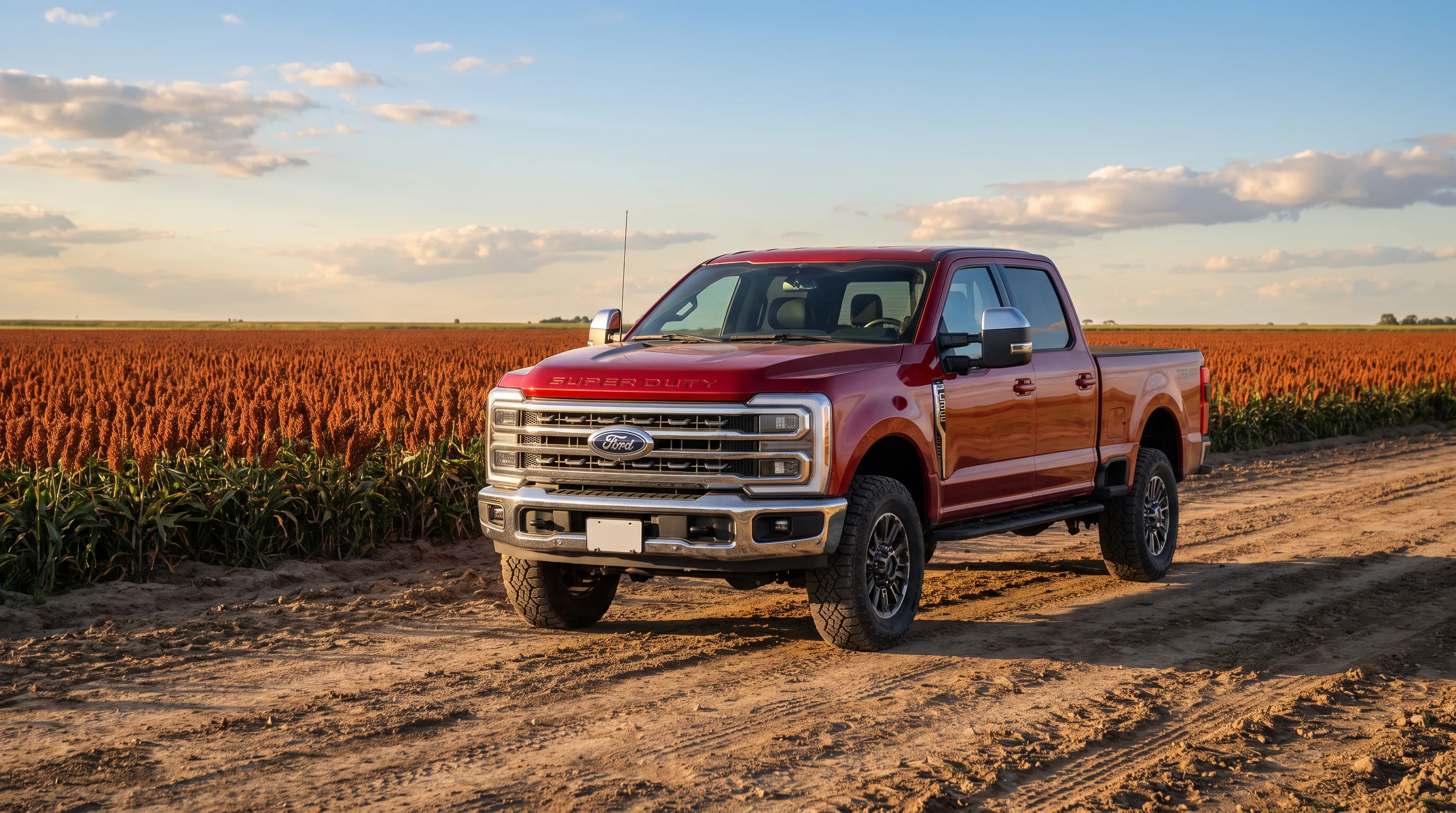
Ford F-250 engines take one of two very different oils, and which one depends entirely on what is under the hood. The 6.8L and 7.3L gas V8s in current Super Duty trucks take SAE 5W-30 meeting Ford specification WSS-M2C961-A1. The 6.7L Power Stroke turbo diesel takes SAE 10W-30 meeting Ford specification WSS-M2C171-F1. Older F-250s are different again: the 5.4L Triton V8 and 6.8L Triton V10 through 2010 used 5W-20, and the 6.4L Power Stroke diesel used heavy-duty diesel oil. Capacity swings just as widely, from 7 quarts on an older gas V8 to 15 quarts on a current Power Stroke.
Getting both halves right matters. Ford states plainly that using oil outside the defined specification and viscosity grade can result in component damage your vehicle warranty does not cover,‖ along with longer cranking, higher emissions and reduced performance. If you are servicing a pre-owned truck or running a farm fleet and you are not certain which engine you have, check the oil fill cap, your owner’s manual, or call our service advisors in Winnsboro at (430) 286-5281.
‖ This information is provided for general educational purposes only and does not constitute legal advice. Warranty coverage depends on the specific terms of your vehicle’s warranty agreement. Consult your owner’s manual or a qualified legal professional for guidance on your individual situation.
Ford F-250 Oil Type, Capacity and Interval at a Glance
| Engine | Years | Oil Type (Normal Fill) | Ford Specification | Capacity with Filter | Oil Change Interval |
|---|---|---|---|---|---|
| Gasoline Engines | |||||
| 7.3L V8 | 2020–2026 | SAE 5W-30 | WSS-M2C961-A1 | 8.0 qt (7.57 L) | IOLM-determined — never exceed 1 year or 10,000 mi |
| 6.8L V8 | 2023–2026 | SAE 5W-30 | WSS-M2C961-A1 | 8.0 qt (7.57 L) | IOLM-determined — never exceed 1 year or 10,000 mi |
| 6.2L V8 | 2011–2022 | SAE 5W-20 | WSS-M2C945-A | 7.0 qt (6.6 L) | IOLM-determined — never exceed 1 year or 10,000 mi |
| 6.8L Triton V10 | Through 2010 | SAE 5W-20 | WSS-M2C930-A | 7.0 qt (6.6 L) | 7,500 mi / 6 mo normal; 5,000 mi / 6 mo / 200 engine hours severe |
| 5.4L Triton V8 | 2005–2010 | SAE 5W-20 | WSS-M2C930-A | 7.0 qt (6.6 L) | 7,500 mi / 6 mo normal; 5,000 mi / 6 mo / 200 engine hours severe |
| Power Stroke Diesel Engines | |||||
| 6.7L High-Output Power Stroke | 2023–2026 | SAE 10W-30 | WSS-M2C171-F1 | 15.0 qt (14.2 L) | IOLM-determined — never exceed 1 year, 10,000 mi or 350 engine hours |
| 6.7L Power Stroke | 2023–2026 | SAE 10W-30 | WSS-M2C171-F1 | 15.0 qt (14.2 L) | IOLM-determined — never exceed 1 year, 10,000 mi or 350 engine hours |
| 6.7L Power Stroke | 2011–2022 | SAE 10W-30 | WSS-M2C171-F1 | 13.0 qt (12.3 L) | IOLM-determined — never exceed 1 year, 10,000 mi or 350 engine hours |
| 6.4L Power Stroke | 2008–2010 | SAE 15W-40 or 5W-40 | WSS-M2C171-D | 15.0 qt (14.2 L) | 7,500 mi / 6 mo normal; 5,000 mi / 6 mo / 200 engine hours severe |
The interval does not change from engine to engine. Every Super Duty in the current lineup leaves that decision to the Intelligent Oil-Life Monitor, so a gas 7.3L and a High-Output Power Stroke follow the same rule. What does change by engine is the oil itself and how much of it the truck holds, and those two columns are where the costly mistakes happen.
The information in this article is general guidance and does not constitute a specific diagnostic or repair recommendation for any individual vehicle. Repair and maintenance decisions should be made in consultation with a certified technician based on the specific condition of your vehicle.
Cited Source: Ford Owner’s Manual — Engine Oil Capacity and Specification — gas engine capacity and specification | Ford Owner’s Manual — Capacities and Specifications, 6.7L Diesel — diesel capacity, viscosity and alternatives | Ford Owner’s Manual — Normal Scheduled Maintenance (Super Duty) — oil change interval tiers and limits | 2010 Ford Scheduled Maintenance Guide — pre-2011 interval and special operating conditions | Ford Owner’s Manual — Capacities and Specifications, 6.8L Triton V10 — V10 capacity and 5W-20 specification | Ford 2023–2026 Super Duty Owner’s Manual — current diesel capacity
What Oil Does a Ford F-250 Take?
Gas Engines: 6.8L and 7.3L V8
Current Super Duty trucks offer four engines: the 6.8L V8 gas, the 7.3L V8 gas, the 6.7L Power Stroke turbo diesel and the 6.7L High-Output Power Stroke turbo diesel. Both gas V8s share the same oil and the same fill quantity. Both diesels share the same Ford specification.
Ford lists SAE 5W-30 meeting WSS-M2C961-A1 for the gas engines, with SAE 0W-30 meeting WSS-M2C963-A1 as the alternative in extremely cold climates.
Power Stroke Diesel: 6.7L Standard and High-Output
For the Power Stroke, Ford lists Motorcraft SAE 10W-30 Super Duty Diesel Motor Oil meeting WSS-M2C171-F1 as the normal fill, with SAE 5W-40 full synthetic for severe-duty service, SAE 5W-40 or 15W-40 for B20 biodiesel blends, and SAE 0W-40 when ambient temperatures reach minus 22 degrees Fahrenheit or below.
One detail trips up a lot of owners buying diesel oil off the shelf. An API CK-4 rating alone does not qualify an oil for a Power Stroke. Ford requires the oil to meet WSS-M2C171-F1 specifically, and Ford’s own guidance is not to use oils showing only CK-4 or CJ-4 in the API donut unless they also carry that Ford approval.
Ford Oil Specification Codes Explained
The viscosity grade on the bottle is only half the requirement. Ford also prints a WSS material specification code, and that code is what actually approves an oil for your engine. These are the codes that appear across the F-250 range:
| Ford Specification | Viscosity | Applies To | Status |
|---|---|---|---|
| WSS-M2C961-A1 | SAE 5W-30 | 6.8L and 7.3L gas V8 | Current |
| WSS-M2C963-A1 | SAE 0W-30 | 6.8L and 7.3L gas V8, extreme cold only | Current cold-climate alternative |
| WSS-M2C171-F1 | SAE 10W-30 normal; 5W-40, 15W-40, 0W-40 alternatives | 6.7L Power Stroke; also supersedes 171-D on the 6.0L and 6.4L diesels | Current |
| WSS-M2C945-A | SAE 5W-20 | 6.2L V8 and later 6.8L Triton V10 applications | Superseded for current engines |
| WSS-M2C930-A | SAE 5W-20 | 5.4L Triton V8 and 6.8L Triton V10 through 2010 | Superseded by WSS-M2C945-A |
| WSS-M2C171-D | SAE 15W-40 or 5W-40 | 6.4L Power Stroke, 2008–2010 | Superseded by WSS-M2C171-F1 in 2016 |
Cited Source: Ford Owner’s Manual — Engine Oil Capacity and Specification — current gas specifications | Ford Owner’s Manual — Capacities and Specifications, 6.7L Diesel — WSS-M2C171-F1 and its alternatives | Ford Owner’s Manual — Capacities and Specifications, 6.8L Triton V10 — WSS-M2C945-A | API Motor Oil Guide — API CK-4 service category definition
Oil Capacity by Engine and Generation
Capacity is where generation matters most, and it is the single most common mistake on an older truck. The 6.7L Power Stroke changed quantity when the Super Duty was redesigned: 2011 through 2022 trucks take 13 quarts, while 2023 and newer trucks take 15 quarts. Pouring the older figure into a newer truck leaves it two quarts low.
Older gas engines are more consistent. The 5.4L Triton V8 and 6.8L Triton V10 in 2005 through 2010 Super Duty trucks both take 7 quarts of 5W-20 with a filter change. The 6.4L Power Stroke diesel in 2008 through 2010 trucks takes 15 quarts. Note that Ford superseded the original WSS-M2C171-D specification for that engine with WSS-M2C171-F1 in 2016, so the current product is the correct one to buy today.
Whatever generation you are working on, verify the level on the dipstick after the engine has settled on level ground. Published capacity is the starting point, not the finish line.
Cited Source: Ford Owner’s Manual — Capacities and Specifications, 6.7L Diesel — 2011–2022 diesel capacity | 2010 Ford F-250/350/450/550 Owner’s Guide — Triton V8 and V10 capacity | 2011 Ford F-250 Owner’s Guide — 6.2L capacity
How Often Should You Change the Oil in a Ford F-250?
Ford does not set a fixed mileage for the Super Duty. Every truck uses the Intelligent Oil-Life Monitor, which determines when the oil needs changing based on how the vehicle is actually used and displays an OIL CHANGE REQUIRED message in the instrument cluster. The correct answer is to change the oil when the monitor asks for it.
The monitor calls for service sooner on trucks that work hard. Ford’s outer limit is one year or 10,000 miles between service intervals, and on the Power Stroke diesel a third limit applies: 350 engine hours, whichever comes first. The monitor must be reset after every oil and filter change. If the display resets prematurely or stops working, Ford’s fallback is six months or 5,000 miles from the last oil change.
The Intelligent Oil-Life Monitor arrived with the 2011 model year. On a 2010 or earlier Super Duty there is no monitor, and the truck follows a fixed schedule instead: 7,500 miles or six months under Ford’s Normal Schedule, dropping to 5,000 miles, six months, or 200 hours of engine operation under Special Operating Conditions, which Ford defines to include towing, heavy loads, extended idling, dusty roads and off-road use.
| How the Truck Is Used | When to Expect the Oil Change Message | Hard Limit |
|---|---|---|
| Normal | 7,500–10,000 miles. Highway commuting, no or moderate load or towing, no extended idling. | 1 year or 10,000 miles. Diesel adds 350 engine hours. |
| Severe | 5,000–7,500 miles. Moderate to heavy load or towing, off-road conditions, extended idling of 200–300 hours, extreme temperatures. | 1 year or 10,000 miles. Diesel adds 350 engine hours. |
| 2010 and earlier (no monitor) | Fixed schedule: 7,500 miles or 6 months normal; 5,000 miles, 6 months or 200 engine hours severe. | As scheduled, whichever comes first. |
Ford treats the following as severe operating conditions:
- Frequent trailer towing or hauling near maximum gross combined weight ratings
- Extended idling or slow-speed stop-and-go driving
- Ambient temperatures above 100 degrees Fahrenheit or below 20 degrees Fahrenheit
- Continuous off-road or dusty work site operation
- Commercial pickup and delivery work
Cited Source: Ford Owner’s Manual — Normal Scheduled Maintenance (Super Duty) — oil change message intervals by use | Ford Owner’s Manual — Normal Scheduled Maintenance, Diesel — one year / 10,000 mi / 350 engine hour limit | 2010 Ford Scheduled Maintenance Guide — pre-2011 fixed schedule and Special Operating Conditions | Ford 2025 Super Duty Scheduled Maintenance Guide — fallback if the monitor resets or fails
Synthetic Blend vs. Full Synthetic for Towing
Full synthetic oil holds up better than synthetic blend under sustained heat. It resists thermal oxidation and shear longer, and it maintains film strength across journal bearings and turbocharger shaft assemblies when sump temperatures climb.
That matters here. Summer highs around Winnsboro average in the low to mid 90s from June through August, and pulling a loaded gooseneck through the rolling country around Wood County puts real heat into the oil. Synthetic blend oils break down faster under those conditions, which shows up as varnish deposits, piston ring sticking and oil thinning. This is exactly why Ford names SAE 5W-40 full synthetic as the severe-duty alternative for the Power Stroke rather than leaving it at the normal fill.
Cited Source: Ford Owner’s Manual — Capacities and Specifications, 6.7L Diesel — severe-duty engine oil alternative | Time and Date climate averages, Winnsboro TX — summer temperature range
Frequently Asked Questions
Can you use passenger-car 5W-30 in a Power Stroke diesel?
No. Passenger-car 5W-30 carries API SP or ILSAC GF-6 ratings, which cap the zinc and phosphorus levels that a diesel valvetrain depends on and do not include the soot dispersants a Power Stroke needs. Using it leads to rapid thermal breakdown, cam lobe wear, oil foaming and engine damage. If you need a lower cold-temperature grade for a Power Stroke, Ford’s options are SAE 5W-40 or SAE 0W-40 meeting WSS-M2C171-F1.
Does the Intelligent Oil-Life Monitor account for heavy idling and trailer towing?
Yes. The monitor determines the service interval from how the vehicle is actually driven rather than from mileage alone, which is why a truck that idles on a job site or tows heavy will be asked for oil sooner than one that commutes on the highway.
Can using non-approved oil void my Ford Super Duty powertrain warranty?
Ford states that using oil that does not meet the defined specification and viscosity grade can result in component damage not covered by your vehicle warranty.‖ Ford requires WSS-M2C171-F1 for the 6.7L Power Stroke and WSS-M2C961-A1 for the current gas V8s. Keep your service receipts showing the oil specification so your maintenance record is documented.
‖ This information is provided for general educational purposes only and does not constitute legal advice. Warranty coverage depends on the specific terms of your vehicle’s warranty agreement. Consult your owner’s manual or a qualified legal professional for guidance on your individual situation.
Why does a Ford F-250 need to be parked on level ground to check the dipstick?
Super Duty oil pans are wide and hold a lot of fluid, up to 15 quarts on a current diesel. Even a small tilt shifts enough oil inside the sump to give a false high or low reading, which is how trucks end up overfilled or underfilled by a quart.
Keep Your Super Duty Running Strong at Texas Country Ford
Using the right oil and the right quantity is the cheapest protection available for a truck that tows and works. Whether your Super Duty runs the 6.7L Power Stroke or the 7.3L V8, factory-approved oil and OEM filters are what stand between heavy thermal loads and premature wear.
Our Ford-certified technicians know the exact fluid specifications, filter part numbers and severe-duty schedules for every generation of the F-250. Stop by our dealership in Winnsboro, schedule service online, or call our service department at (430) 286-5281. More maintenance guidance is collected on our Service & Parts Tips hub, and current oil change offers and The Works package are listed on our oil change page.
Disclaimers
‖ This information is provided for general educational purposes only and does not constitute legal advice. Warranty coverage depends on the specific terms of your vehicle’s warranty agreement. Consult your owner’s manual or a qualified legal professional for guidance on your individual situation.
The information in this article is general guidance and does not constitute a specific diagnostic or repair recommendation for any individual vehicle. Repair and maintenance decisions should be made in consultation with a certified technician based on the specific condition of your vehicle.
Cited Sources
Ford Owner’s Manual — Engine Oil Capacity and Specification — gas engine capacity and specification | Ford Owner’s Manual — Capacities and Specifications, 6.7L Diesel — diesel capacity, viscosity grades and severe-duty alternative | Ford Owner’s Manual — Normal Scheduled Maintenance (Super Duty) — oil change message intervals | Ford Owner’s Manual — Normal Scheduled Maintenance, Diesel — engine hour limit | Ford Owner’s Manual — Capacities and Specifications, 6.8L Triton V10 — V10 capacity and specification | 2010 Ford Scheduled Maintenance Guide — pre-2011 interval and Special Operating Conditions | API Motor Oil Guide — API CK-4 service category definition | Ford 2023–2026 Super Duty Owner’s Manual — current diesel capacity | 2010 and 2011 Ford F-250 Owner’s Guides — earlier engine capacities | Time and Date climate averages, Winnsboro TX — summer temperature range

